

Whenever I hear the phrase, “you’ve got this,” I have a small, instinctive cringe.
Not because I doubt myself — but because experience has taught me something different about complex challenges: the more complicated a problem, the less likely it is that anyone can confidently predict the outcome. Progress rarely comes from bold declarations; it comes from trial and error, adjustments, and learning from outcomes you can’t fully control.
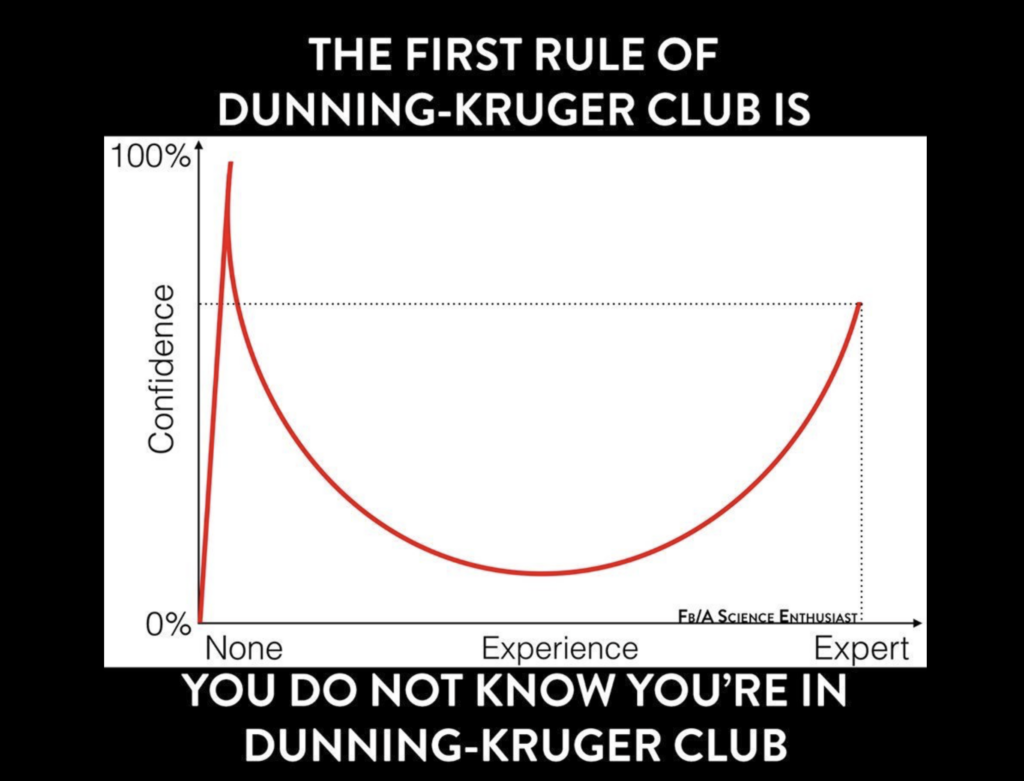
That made me wonder: why do some people seem so certain about things I know to be complicated? The answer lies in something called the Dunning–Kruger effect.
What is the Dunning–Kruger Effect?
It’s a simple but powerful cognitive bias: people with limited knowledge in a subject can overestimate their competence, while experts, aware of the complexity, may appear overly hesitant.
Here’s how it often shows up in organisations:
- Assuming problems are simple
Complex systems—policies, projects, or institutional structures—are treated as if they have obvious fixes. - Rapid, sweeping solutions
Quick proposals emerge to “fix” the problem without full understanding of dependencies or consequences. - Encountering unexpected complexity
Legal issues, institutional processes, and unintended outcomes emerge once action begins. - Doubling down instead of learning
Instead of adapting or collaborating, instinct often drives defensiveness, blame, or pushing forward regardless.
Why it matters in leadership
Fresh perspectives can be valuable — history is full of outsiders improving systems insiders overlooked. But when confidence runs ahead of understanding, the stakes are high. Decisions affecting organisations, policies, or long-standing programs can have far-reaching consequences if they’re guided by certainty rather than insight.
This isn’t just about being “decisive.” People who truly understand complexity are often the ones saying:
- “The evidence is mixed.”
- “It depends.”
- “This will take time.”
To some, that can feel less compelling than bold, quick promises. But it’s these cautious voices that often prevent costly mistakes.
What to watch for
If a leader consistently shows:
- High confidence in quick judgments
- Dismissal of expert insight
- Over-simplification of complex problems
…it’s a red flag. Confidence is valuable, but wisdom comes from understanding the variables, trade-offs, and unintended consequences before acting.
The key takeaway
The Dunning–Kruger effect isn’t just a psychological curiosity — it’s a practical leadership lesson:
Confidence without expertise can be dangerous; expertise without visible certainty can be undervalued.
The leaders, managers, and professionals who recognise this balance are the ones who guide organisations safely through complexity — not by claiming “we’ve got this,” but by asking questions, learning continuously, and acknowledging what they may not know yet.
Actionable thought
Next time you encounter bold certainty in a colleague, client, or executive, pause and ask: “Do they fully understand the complexity of this?” And next time you’re told, “You’ve got this,” maybe it’s okay to think: “Let’s work this out together.”
Click here for more information
Contact me if you need helpful guidance on your HR issues


